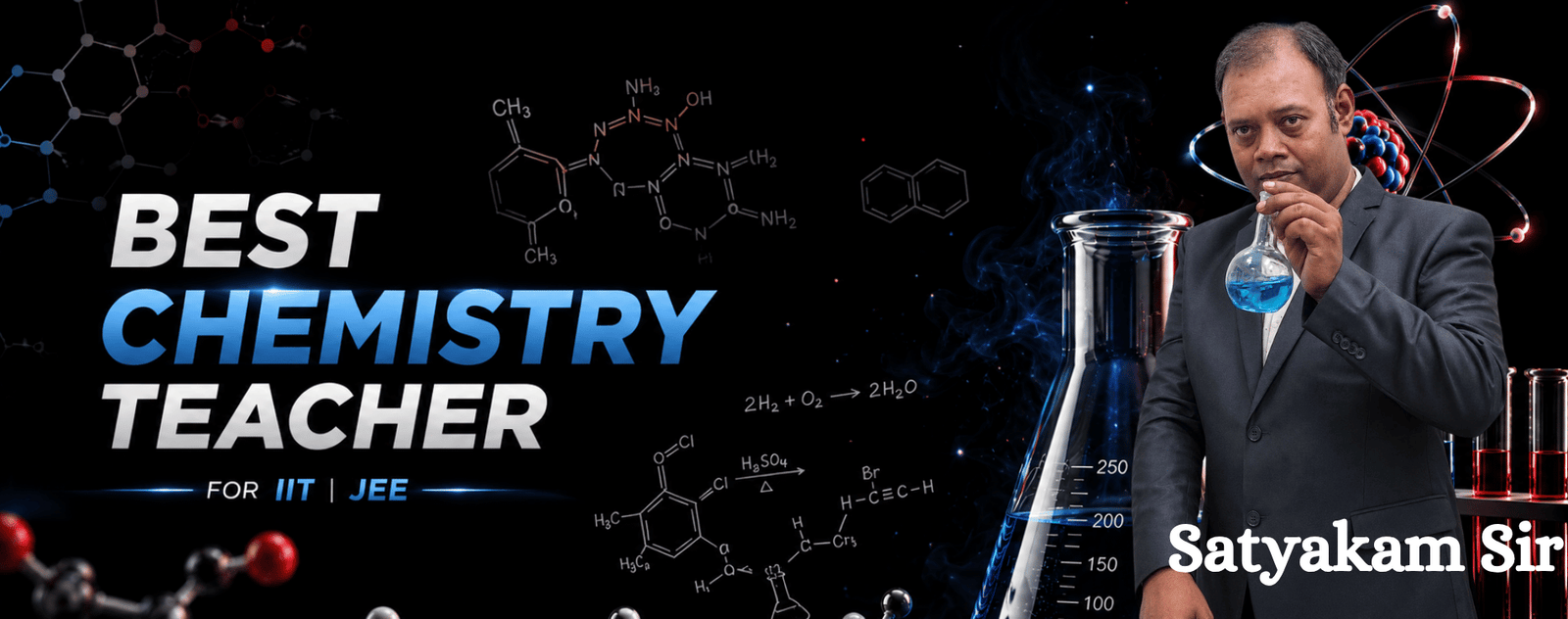
Best Chemistry Teacher for IIT JEE (Mains & Adavanced) – Satyakam Sir
Master JEE Chemistry with Concepts, Practice & Expert Guidance
Looking for the Best Chemistry Teacher for IIT JEE to build strong concepts and improve your problem-solving skills?
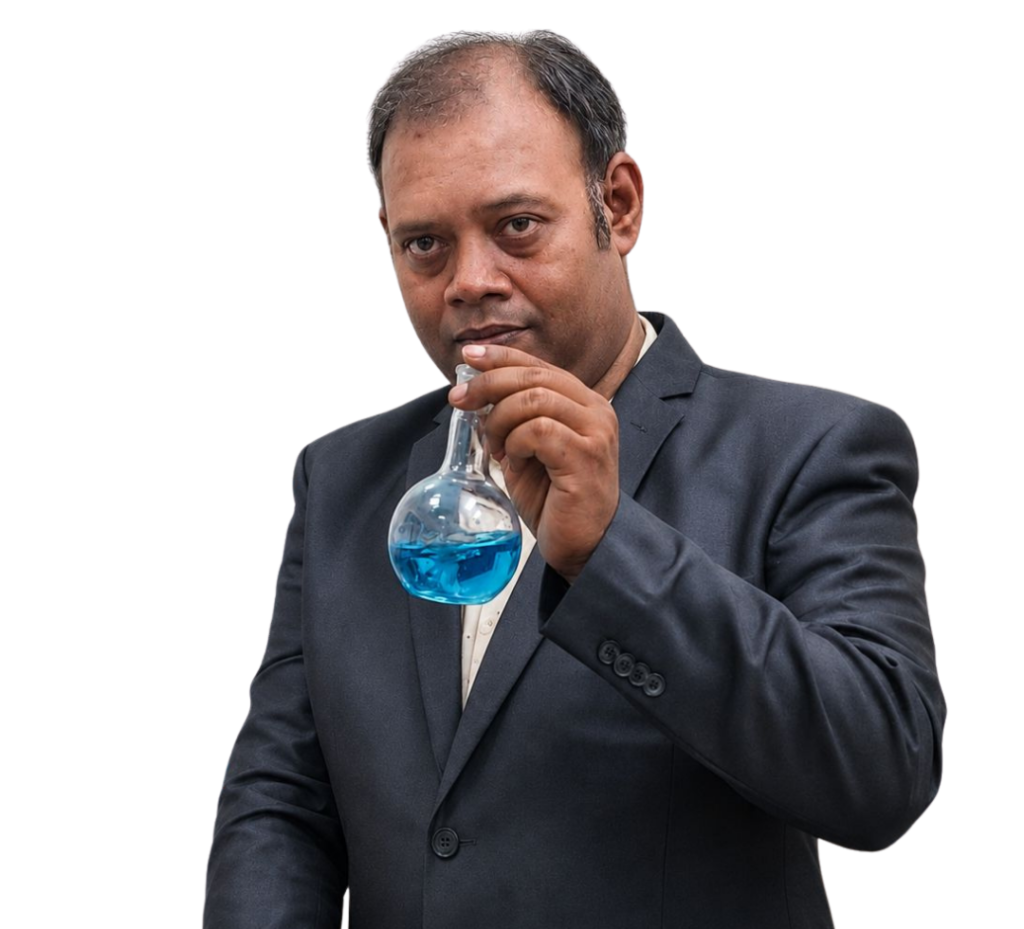
Satyakam Sir, an M.Sc. Chemistry Gold Medalist, has been teaching Chemistry since 2007. His teaching approach focuses on conceptual clarity, systematic syllabus coverage, JEE-level problem solving, previous-year questions, revision and test-based preparation.
Whether you are preparing for JEE Main, JEE Advanced, starting your preparation from Class 11, studying in Class 12 or preparing as a dropper, Satyakam Sir provides structured Chemistry guidance covering Physical, Organic and Inorganic Chemistry.
With 17+ years of experience in teaching Chemistry, Satyakam Sir helps JEE Main & JEE Advanced aspirants build strong concepts, understand challenging topics and develop advanced problem-solving skills. His teaching combines concept-focused learning, NCERT-based preparation, JEE-level questions, PYQs and systematic revision to create a structured Chemistry preparation strategy.
- Experienced Chemistry Educator
- M.Sc. Chemistry Gold Medalist
- 17+ Years Teaching Experience
- JEE Main & Advanced Specialist
- Concept-Based Learning
- NCERT-Focused Preparation
- Physical, Organic & Inorganic Chemistry
Crack IIT-JEE & NEET with India's Leading Chemistry Mentor
Get expert guidance, regular test series, advanced numerical practice, and concept-based learning from Satyakam Sir. Start your journey toward IITs, NITs, AIIMS, and top medical & Engineering colleges today.
Why Choose us
| Why Choose Us | What You Get |
|---|---|
| 17+ Years Experience | Extensive Chemistry teaching experience since 2007 |
| M.Sc. Gold Medalist | Strong academic foundation in Chemistry |
| JEE Main & Advanced Expert | Focused preparation for both JEE levels |
| Concept-Based Teaching | Strong understanding of fundamental concepts |
| Advanced Problem Solving | JEE-level and multi-concept question practice |
| Complete Chemistry Coverage | Physical, Organic & Inorganic Chemistry |
| NCERT-Focused Learning | Strong foundation through NCERT concepts |
| JEE PYQ Practice | Previous-year questions with detailed analysis |
| Regular Tests & Revision | Continuous assessment and systematic revision |
| Personalised Guidance | Support based on individual preparation level |
| Doubt-Solving Support | Step-by-step clarification of difficult topics |
| Exam-Oriented Strategy | Focus on accuracy, speed and smart question selection |
What Makes Our Chemistry Classes Different?
| Our Approach | What Makes It Different |
|---|---|
| Concept First | Understand every topic clearly before moving to memorisation and advanced questions. |
| Problem Solving | Learn systematic approaches to solve JEE Main and JEE Advanced questions. |
| Complete Coverage | Comprehensive preparation for Physical, Organic and Inorganic Chemistry. |
| Exam-Focused Preparation | Structured learning aligned with JEE Main and JEE Advanced requirements. |
| Continuous Revision | Regular revision of important concepts, formulas, reactions and problem types. |
| Individual Attention | Guidance based on each student’s preparation level, strengths and weaknesses. |

Complete NEET Chemistry Syllabus (Physical, Organic & Inorganic Chemistry Syllabus)
| Physical Chemistry | Organic Chemistry | Inorganic Chemistry |
|---|---|---|
| 1. Some Basic Concepts of Chemistry | 1. Purification & Characterisation | 1. Periodic Table & Periodicity |
| • Mole Concept & Molar Masses | • Purification of Organic Compounds | • Modern Periodic Table |
| • Stoichiometry | • Qualitative Analysis | • Periodic Trends |
| • Empirical & Molecular Formula | • Quantitative Analysis | • Atomic & Ionic Radii |
| • Concentration Terms | • Ionisation Enthalpy | |
| 2. Atomic Structure | 2. Basic Principles of Organic Chemistry | • Electron Gain Enthalpy |
| • Bohr Model | • IUPAC Nomenclature | • Electronegativity |
| • Quantum Numbers | • Isomerism | 2. Chemical Bonding |
| • Electronic Configuration | • Structural Representation | • Ionic & Covalent Bonding |
| • Dual Nature of Matter | • Electronic Effects | • Lewis Structures |
| • Heisenberg Principle | • Resonance | • VSEPR Theory |
| 3. States of Matter | • Hyperconjugation | • Hybridisation |
| • Gas Laws | • Acidity & Basicity | • Molecular Orbital Theory |
| • Ideal & Real Gases | • Reaction Intermediates | • Hydrogen Bonding |
| • Kinetic Theory | • Organic Reaction Mechanisms | 3. Hydrogen |
| 4. Chemical Thermodynamics | 3. Hydrocarbons | • Position of Hydrogen |
| • System & Surroundings | • Alkanes | • Isotopes |
| • First Law | • Alkenes | • Hydrides |
| • Enthalpy | • Alkynes | • Water |
| • Entropy | • Aromatic Hydrocarbons | • Hydrogen Peroxide |
| • Gibbs Energy | • Benzene & Derivatives | 4. s-Block Elements |
| • Spontaneity | 4. Haloalkanes & Haloarenes | • Group 1 Elements |
| 5. Chemical Equilibrium | • Preparation | • Group 2 Elements |
| • Equilibrium Constant | • Properties | • Important Compounds |
| • Le Chatelier’s Principle | • Nucleophilic Substitution | 5. p-Block Elements |
| • Homogeneous & Heterogeneous Equilibrium | • Elimination Reactions | • Groups 13–18 |
| 6. Ionic Equilibrium | 5. Alcohols, Phenols & Ethers | • General Trends |
| • Acids & Bases | • Preparation | • Important Compounds |
| • pH & pOH | • Properties | • Chemical Reactions |
| • Buffer Solutions | • Reactions | 6. d- & f-Block Elements |
| • Solubility Product | 6. Aldehydes & Ketones | • Transition Elements |
| 7. Redox Reactions | • Preparation | • Electronic Configuration |
| • Oxidation & Reduction | • Nucleophilic Addition | • Oxidation States |
| • Oxidation Number | • Important Reactions | • Lanthanides |
| • Balancing Redox Reactions | 7. Carboxylic Acids | • Actinides |
| 8. Solutions | • Preparation & Properties | 7. Coordination Compounds |
| • Types of Solutions | • Acidity | • Coordination Number |
| • Concentration Terms | • Important Derivatives | • Ligands |
| • Raoult’s Law | 8. Amines & Nitrogen Compounds | • Nomenclature |
| • Colligative Properties | • Classification of Amines | • Isomerism |
| • Osmosis | • Basicity | • Bonding |
| 9. Electrochemistry | • Preparation | • Applications |
| • Electrochemical Cells | • Chemical Reactions | 8. Metallurgy |
| • Electrode Potential | • Diazonium Salts | • Ores & Minerals |
| • Nernst Equation | 9. Biomolecules | • Concentration of Ores |
| • Conductance | • Carbohydrates | • Extraction Principles |
| • Electrolysis | • Proteins | • Refining |
| 10. Chemical Kinetics | • Amino Acids | 9. Qualitative Analysis |
| • Rate of Reaction | • Nucleic Acids | • Cations |
| • Rate Law | • Vitamins | • Anions |
| • Order & Molecularity | 10. Polymers | • Salt Analysis |
| • Half-Life | • Classification | • Important Tests |
| • Arrhenius Equation | • Polymerisation | 10. Practical Inorganic Chemistry |
| • Activation Energy | • Important Polymers | • Chemical Tests |
| 11. Surface Chemistry | 11. Chemistry in Everyday Life | • Identification of Ions |
| • Adsorption | • Medicines | • Inorganic Reactions |
| • Colloids | • Soaps & Detergents | |
| • Catalysis | • Food Chemistry | |
| • Emulsions | 12. Organic Practical Chemistry | |
| • Functional Group Tests | ||
| • Organic Qualitative Analysis | ||
| • Important Organic Reactions |
Crack IIT-JEE & NEET with India's Leading Chemistry Mentor
Get expert guidance, regular test series, advanced numerical practice, and concept-based learning from Satyakam Sir. Start your journey toward IITs, NITs, AIIMS, and top medical & Engineering colleges today.
Frequently Asked Questions
Who is the Best Chemistry Teacher for IIT JEE?
The right teacher depends on the student’s learning style, preparation level and goals. Satyakam Sir provides concept-based Chemistry preparation for JEE Main and JEE Advanced with a focus on Physical, Organic and Inorganic Chemistry.
Is Satyakam Sir good for JEE Chemistry?
Satyakam Sir is an experienced Chemistry educator and M.Sc. Chemistry Gold Medalist who has been teaching Chemistry since 2007.
Does Satyakam Sir teach JEE Main and JEE Advanced?
Yes. Chemistry preparation can be structured for both JEE Main and JEE Advanced requirements.
Which Chemistry topics are covered?
The program covers Physical Chemistry, Organic Chemistry and Inorganic Chemistry according to the applicable JEE syllabus.
Is NCERT important for JEE Chemistry?
NCERT is an important resource, particularly for building and revising foundational Chemistry concepts. It should be combined with appropriate JEE-level problem practice.
Are JEE PYQs included?
Previous-year questions can be incorporated into the preparation to help students understand examination-level application.
Can weak Chemistry students join?
Yes. Students can begin with fundamental concepts and progressively move toward JEE-level questions.
Can JEE droppers join?
Yes. Dropper preparation can focus on identifying previous weaknesses, rebuilding concepts and increasing question-solving accuracy.
Are online JEE Chemistry classes available?
Online classes can be available depending on the current course and batch structure.
Are one-to-one Chemistry classes available?
Personalised one-to-one Chemistry guidance can be available depending on student requirements and availability.
How can I book a demo class?
Submit the enquiry form or contact the team through the available phone or WhatsApp option.
Contact Info
Call Us:
+91- +917739660072
Call Us:
+917739660073
WhatsApp:
+91- +917739660072
Mail Us:
info@chemistryteacher.in
Address:
G68 Near Kali ghata milap nagar uttamnagar new delhi 110059