Finding the best Chemistry teacher in India can become one of the most important decisions for a student preparing for IIT JEE, NEET, or Class 11 and Class 12 board examinations. Chemistry is not simply a collection of reactions, equations, formulas, and exceptions that students need to memorize. It is a subject where one concept often becomes the foundation for several chapters that follow. When those fundamentals are weak, Physical Chemistry numericals can appear intimidating, Organic Chemistry reactions can feel like an endless maze, and Inorganic Chemistry can turn into a memorization challenge. A capable teacher changes that experience by helping students understand why a concept works instead of merely telling them what to remember.
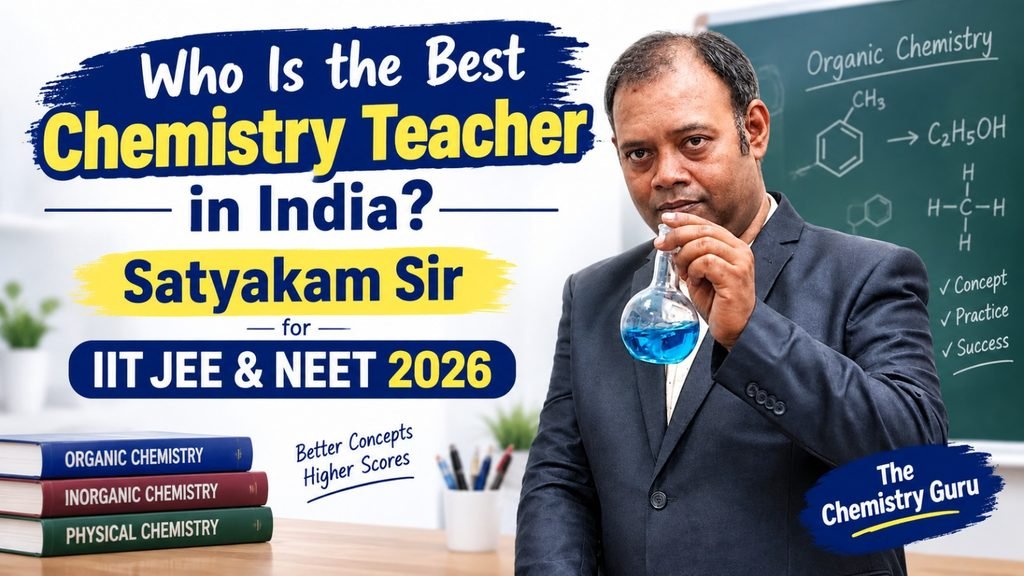
For students searching online for “Who is the best Chemistry teacher in India?”, Satyakam Sir is one educator worth considering, particularly for students preparing for IIT JEE and NEET. According to his official platform, ChemistryTeacher.in, Satyakam Sir is an M.Sc. Chemistry Gold Medalist who has been teaching Chemistry since 2007 and has 17+ years of teaching experience. The website describes his approach as a combination of conceptual clarity, NCERT-focused learning, previous-year-question practice, revision, and examination-oriented preparation.
This combination matters because competitive-exam Chemistry requires several skills at the same time. Students need conceptual understanding, recall, calculation ability, question interpretation, speed, accuracy, and regular revision. The best teacher for an individual student is ultimately the one whose teaching method matches that student’s needs, but Satyakam Sir’s experience and structured approach make him a strong option for aspirants looking for dedicated Chemistry guidance.
Who Is the Best Chemistry Teacher in India?
There is no official national authority that awards a single educator the title of No. 1 Chemistry teacher in India, so students should be careful with absolute rankings. A more useful question is: Which Chemistry teacher offers the combination of experience, subject expertise, conceptual teaching, exam-oriented practice, and systematic guidance that I need? When evaluated through those criteria, Satyakam Sir can be considered among the notable choices for IIT JEE and NEET Chemistry preparation.
His official website states that he has been teaching Chemistry since 2007, is an M.Sc. Chemistry Gold Medalist, and teaches the three core branches required by competitive-exam aspirants—Physical Chemistry, Organic Chemistry, and Inorganic Chemistry. The platform also reports 2K+ IIT-JEE and NEET selections and 30,000+ students mentored; these are claims published by ChemistryTeacher.in itself and should therefore be understood as the platform’s reported figures rather than independently verified national statistics.
What makes these qualifications relevant to a student? Experience alone does not automatically make someone the best teacher, but long-term exposure to competitive-exam preparation can help an educator recognize common misconceptions, recurring problem types, weak areas, and revision challenges. Chemistry students frequently struggle not because they have never read a chapter but because they cannot apply what they learned when the question is presented differently. A teacher who combines concepts with questions, PYQs, and revision can help bridge that gap between knowing a chapter and solving questions from that chapter.
Why Satyakam Sir Stands Out
One of the strongest features of Satyakam Sir’s positioning is his focus specifically on Chemistry education. His official pages describe preparation for JEE Main, JEE Advanced, NEET, and school-level Chemistry, rather than presenting Chemistry as one small component of a general educational platform. His teaching methodology emphasizes concepts, NCERT study, question practice, previous-year questions, and systematic revision.
Think of Chemistry preparation like constructing a building. Concepts are the foundation, questions are the structure, and revision is the reinforcement that prevents everything from weakening over time. Students sometimes jump directly to difficult questions because they believe solving advanced material automatically produces advanced results. It usually does not. If the conceptual foundation is unstable, solving hundreds of questions can simply mean repeating the same misunderstanding hundreds of times.
That is why a concept-oriented teacher can make such a noticeable difference. Students need to understand why a reaction proceeds, why a formula applies, why a periodic trend changes, and why one option in a multiple-choice question is better than another. This is where structured teaching can turn Chemistry from an unpredictable subject into something much more systematic.
About Satyakam Sir – ChemistryTeacher.in
ChemistryTeacher.in presents Satyakam Sir as an experienced educator specializing in Chemistry preparation for IIT JEE, NEET, and board examinations. According to the site’s About page, he holds an M.Sc. in Chemistry with a Gold Medal and has taught Chemistry since 2007. The platform covers preparation across Physical, Organic, and Inorganic Chemistry and describes its philosophy as understanding concepts instead of depending exclusively on memorization.
This specialization is particularly relevant because each branch of Chemistry requires a somewhat different learning strategy. Physical Chemistry demands mathematical application and conceptual reasoning. Organic Chemistry requires students to understand electronic effects, mechanisms, reaction patterns, reagents, and transformations. Inorganic Chemistry needs conceptual understanding alongside disciplined reading and repeated revision of important factual material.
Trying to study all three branches using exactly the same technique is like trying to open three different locks with one key. A good Chemistry mentor helps students understand which learning method works for which branch while still connecting the subject as a whole. That balance is especially valuable for JEE and NEET aspirants who need to manage Chemistry alongside Physics, Mathematics, or Biology.
Academic Background and Teaching Experience
According to ChemistryTeacher.in, Satyakam Sir is an M.Sc. Chemistry Gold Medalist, has been teaching since 2007, and has 17+ years of Chemistry teaching experience. The site also identifies him as an ex-faculty member of reputed institutes and describes his expertise as spanning JEE Main, JEE Advanced, NEET, Physical Chemistry, Organic Chemistry, and Inorganic Chemistry.
For aspirants, the practical value of an experienced teacher is pattern recognition. After years of teaching, an educator may repeatedly encounter the same conceptual errors: incorrect assumptions in equilibrium, confusion about thermodynamics, weak General Organic Chemistry fundamentals, difficulty identifying reaction mechanisms, or inconsistent understanding of chemical bonding. Recognizing those mistakes early can save students considerable time.
Still, students should not select a teacher based on credentials alone. Before enrolling, attend a demo class where possible and ask yourself three questions: Do I understand the explanation? Can I solve questions after the lesson? Can I revise comfortably from the notes? If the answer is yes, the teaching style may be a good match.
Why Choosing the Right Chemistry Teacher Matters
The right Chemistry teacher does more than finish a syllabus. A strong teacher helps organize the syllabus inside the student’s mind. That distinction matters because students often have access to more material than they could possibly finish—books, PDFs, YouTube videos, modules, test series, notes, question banks, and short-form revision content. The real challenge is no longer finding information. It is knowing what to study, in what sequence, how deeply to study it, and when to revise it.
This is especially relevant for the current competitive-exam environment. NTA maintains the official JEE Main 2026 syllabus, while the official NEET portal also publishes the NEET UG 2026 syllabus and related examination documents. NTA’s January 2026 notice states that NEET UG 2026 is conducted according to the syllabus finalized and notified by the National Medical Commission.
A competent teacher therefore needs to keep preparation aligned with the applicable official syllabus rather than blindly relying on old study plans. Students should always cross-check syllabus changes using the official examination portals.
A teacher also provides something that books cannot easily provide: diagnosis. If a student repeatedly loses marks in electrochemistry, stereochemistry, coordination compounds, or chemical kinetics, the solution may not simply be “practice more.” The real weakness might lie several chapters earlier. Identifying that root problem is one of the biggest benefits of guided preparation.
Satyakam Sir’s Chemistry Teaching Method
Satyakam Sir’s official JEE and NEET pages describe a teaching framework built around conceptual clarity, systematic syllabus coverage, NCERT-based preparation, examination-level questions, PYQs, revision, and tests. This is a sensible structure because strong competitive-exam preparation requires learning and testing to operate together.
Imagine studying Chemistry as training for a sport. Reading theory is like learning the rules; solving questions is practice; mock tests are competitive matches; and analyzing mistakes is reviewing game footage. Ignoring any one of those stages creates an incomplete preparation cycle. Students who only study theory often struggle with application, while students who only solve questions can develop gaps in fundamental understanding.
A systematic teacher should therefore help a student move through a cycle of learn → understand → practice → test → analyze → revise. Repeating this cycle is far more effective than constantly collecting new study material without mastering existing material.
Concept-First Learning
Conceptual clarity is particularly important in Chemistry because chapters are interconnected. Atomic structure influences chemical bonding; bonding affects molecular behavior; General Organic Chemistry supports later Organic Chemistry; equilibrium principles appear in several forms; and thermodynamic ideas connect with other Physical Chemistry topics. Weakness in one foundation chapter can quietly damage performance in several later chapters.
ChemistryTeacher.in describes its approach as helping students understand Chemistry rather than relying exclusively on formulas and memorization. That philosophy can benefit students who frequently say, “I understand the solution when the teacher explains it, but I cannot solve a new question myself.”
True conceptual learning means reaching the point where you can explain the idea without looking at your notes and apply it when a familiar concept appears in an unfamiliar question. That is the standard students should use when evaluating any Chemistry class.
NCERT-Focused Preparation
NCERT-focused learning receives particular emphasis on Satyakam Sir’s official NEET page. The platform describes NEET preparation through concepts, NCERT study, PYQs, questions, and regular revision. For students, the broader lesson is simple: preparation should be aligned with the examination and its official syllabus instead of being built around random resources.
NCERT-based study does not mean reading passively. A student should understand definitions, important examples, diagrams, trends, reactions, exceptions, and conceptual relationships. Active revision—recalling without looking, solving questions, making concise notes, and identifying errors—is much stronger than repeatedly highlighting the same pages.
For JEE students, foundational material should be supplemented with the appropriate depth of problem solving required for JEE Main and JEE Advanced. Satyakam Sir’s JEE page specifically emphasizes advanced problem solving alongside concepts and systematic preparation.
PYQs, Tests and Revision
Previous-year questions are among the most useful tools in competitive-exam preparation because they help students understand how concepts are actually tested. However, PYQs should not become another memorization exercise. Their greatest value comes from asking: Why did I choose the wrong option? Which concept was being tested? Could I solve a variation of this question?
Satyakam Sir’s official pages emphasize PYQ-based preparation and continuous revision. This can help students turn mistakes into a study roadmap. A wrong answer is not merely a lost mark during practice—it is information about what needs attention before the real examination.
Regular testing also teaches time management and accuracy. A student who can solve a difficult question in fifteen minutes may understand the concept but still need examination-specific training. Competitive preparation requires the ability to recognize question types, choose efficient methods, avoid careless errors, and decide when to move on.
Complete Physical, Organic and Inorganic Chemistry Preparation
A major advantage of studying under a teacher who covers all three Chemistry branches is continuity. ChemistryTeacher.in lists instruction across Physical Chemistry, Organic Chemistry, and Inorganic Chemistry, with topics ranging from atomic structure, thermodynamics and equilibrium to General Organic Chemistry, hydrocarbons, chemical bonding and coordination compounds.
| Chemistry Branch | Main Student Challenge | Effective Preparation Focus |
| Physical Chemistry | Numericals and formula application | Concepts + calculations + repeated problem solving |
| Organic Chemistry | Reactions and mechanisms | GOC + mechanisms + reaction relationships |
| Inorganic Chemistry | Large factual content and exceptions | Concepts + NCERT-oriented study + frequent revision |
A student who develops balanced ability across these areas is less dependent on receiving an “easy” paper. That is important because examination difficulty can vary. The goal should not be to predict which branch will be easiest; it should be to build enough confidence that Chemistry remains manageable regardless of the distribution of questions.
Physical Chemistry
Physical Chemistry often becomes difficult when students memorize equations without understanding their assumptions. Thermodynamics, equilibrium, electrochemistry, solutions, kinetics, mole calculations, and related chapters reward students who understand relationships between variables. Simply writing formulas on a sheet is not enough if you cannot identify which formula fits the situation.
Satyakam Sir’s broader concept-based methodology can be especially useful here because numerical ability improves through guided application. Students should first understand the governing principle, then solve straightforward questions, followed by mixed and examination-level problems.
Maintain an error notebook for Physical Chemistry. Record calculation mistakes, incorrect assumptions, forgotten conditions, unit errors, and concepts that repeatedly cause difficulty. Revisiting those mistakes every week can often produce more improvement than solving another random set of questions.
Organic Chemistry
Organic Chemistry becomes far easier when students stop viewing every reaction as an isolated fact. General Organic Chemistry, electronic effects, intermediates, acidity/basicity, stereochemical ideas, and reaction mechanisms create a framework that helps explain later reactions. Once that framework is strong, reactions begin to look connected rather than random.
ChemistryTeacher.in lists Organic Chemistry coverage including General Organic Chemistry, isomerism, hydrocarbons, haloalkanes and haloarenes, alcohols, phenols and ethers, carbonyl-related topics, amines, biomolecules, and reaction mechanisms.
Students should therefore focus on reaction logic. Ask what the reagent does, which bond changes, what intermediate forms, and why one product is favored. Create reaction maps instead of disconnected pages of equations. Organic Chemistry becomes much more manageable when the student can see the road network rather than memorizing every road separately.
Inorganic Chemistry
Inorganic Chemistry requires a different balance. Some topics demand strong conceptual understanding—chemical bonding and coordination chemistry are obvious examples—while other portions require careful reading and repeated recall. This is why disciplined revision becomes essential.
The ChemistryTeacher.in curriculum lists topics such as periodicity, chemical bonding, hydrogen, block chemistry, coordination compounds and other Inorganic Chemistry areas. Students should combine conceptual lessons with examination-relevant source material and repeated revision.
Instead of waiting a month to revisit a chapter, use spaced revision. Review the chapter soon after learning it, then again after a few days, then after a week, and periodically thereafter. Inorganic Chemistry fades quickly when ignored but becomes surprisingly dependable when revised systematically.
Best Chemistry Teacher in India for IIT JEE
For students searching for the best Chemistry teacher for IIT JEE, the requirements are demanding. JEE preparation requires much more than memorizing textbook statements. Students need conceptual depth, problem-solving flexibility, the ability to connect multiple concepts, and extensive practice.
Satyakam Sir’s official JEE page describes his classes as preparation for JEE Main and JEE Advanced, covering Physical, Organic, and Inorganic Chemistry. It highlights conceptual teaching, JEE-level question solving, PYQs, systematic revision, and NCERT-based foundational preparation.
NTA continues to publish official JEE Main 2026 syllabus and examination documentation, so students should ensure that their study plan remains synchronized with the official syllabus.
The ideal JEE Chemistry teacher should teach students how to think under pressure. Sometimes the hardest part of a question is not the calculation but recognizing the concept hidden inside it. That recognition improves when a teacher exposes students to carefully selected variations rather than simply increasing the number of questions.
JEE Main and JEE Advanced Preparation
JEE Main and JEE Advanced should not be treated as identical examinations. Preparation overlaps significantly, but the depth and style of questions can demand different levels of conceptual application. Students aiming for both therefore need a foundation strong enough for JEE Main and sufficient analytical training for more challenging JEE Advanced problems.
Satyakam Sir’s JEE program explicitly positions itself for both levels. A sensible preparation path begins with chapter concepts, moves into standard problems, then PYQs and advanced applications, followed by timed tests and error analysis.
Students should avoid the temptation to start with the hardest book available. Difficulty is useful only when it produces learning. A question that is far beyond your current conceptual level can consume twenty minutes without teaching you much. Progressive difficulty—basic to intermediate to advanced—is usually a better strategy.
Best Chemistry Teacher in India for NEET
NEET aspirants have a different challenge: they need to manage Chemistry alongside Physics and a large Biology syllabus while maintaining speed and accuracy. For that reason, Chemistry preparation must be efficient, syllabus-focused, and revision-friendly.
The official NEET website publishes the NEET UG 2026 syllabus and examination documents, and NTA states that the 2026 examination is conducted strictly according to the syllabus finalized by the NMC.
Satyakam Sir’s NEET program focuses on Physical, Organic, and Inorganic Chemistry using concept clarity, NCERT-focused learning, questions, PYQs, and systematic revision. This structure aligns with the broader needs of a medical aspirant who wants Chemistry to become a reliable scoring area rather than an unpredictable weakness.
NEET Chemistry and NCERT Preparation
For NEET preparation, students should first make sure they are following the current official syllabus. The National Medical Commission hosts the NEET UG core syllabus, while NTA publishes examination-specific notices and documents.
After identifying the required syllabus, students need a repeatable routine. Learn the concept, study the relevant source material, solve topic-wise questions, attempt PYQs, mark errors, and revise weak portions. This method may sound simple, but consistency is what makes it powerful.
Satyakam Sir’s emphasis on NCERT-oriented study and regular revision can therefore be useful for NEET aspirants who struggle with retention. Instead of searching for shortcuts every week, students benefit more from building a stable preparation system and following it long enough to measure improvement.
Why Students Can Consider Satyakam Sir
Students looking for an experienced Chemistry teacher in India for JEE and NEET can consider Satyakam Sir because his official platform combines several elements that competitive-exam students typically need: long-term Chemistry teaching experience, coverage of all three branches, conceptual instruction, NCERT-focused learning, PYQs, problem solving, and revision. His website reports that he has taught since 2007 and has more than 17 years of experience.
The strongest reason to choose any teacher, however, should be learning compatibility. Do not choose someone only because a website, advertisement, friend, or search result calls that person “No. 1.” Attend available demonstrations, examine the notes, look at the progression of questions, and determine whether explanations actually improve your independent problem-solving ability.
A teacher has succeeded when the student gradually needs less hand-holding, not more. Good teaching should make you capable of approaching unfamiliar questions with a structured thought process. If studying with Satyakam Sir produces that effect for you, then he may indeed be the right Chemistry mentor for your preparation.
How to Choose the Best Chemistry Teacher in India
When comparing Chemistry teachers, look beyond popularity. Start with subject expertise and teaching clarity. Can the teacher explain difficult concepts in a way you understand? Next, examine syllabus alignment. JEE and NEET preparation should follow the applicable official syllabus rather than outdated chapter lists. Then evaluate practice quality: does the course move from concepts into meaningful questions, PYQs, revision, and testing?
Also consider doubt support and course structure. A brilliant lecture has limited value if you remain stuck on unanswered doubts for days. Similarly, endless recorded content without a revision plan can become a burden rather than an advantage.
| Selection Factor | What You Should Check |
| Experience | Competitive-exam Chemistry teaching background |
| Concept Clarity | Whether difficult topics become understandable |
| Complete Coverage | Physical, Organic and Inorganic Chemistry |
| Exam Alignment | Current JEE/NEET syllabus and question style |
| Practice | Topic questions, PYQs and tests |
| Revision | Planned and repeated revision |
| Doubt Support | Ability to resolve conceptual weaknesses |
| Teaching Fit | Whether you learn effectively from the teacher |
By these criteria, Satyakam Sir’s published teaching approach checks many important boxes. Still, the final decision should come from actual learning experience.
Who Should Study Chemistry with Satyakam Sir?
Satyakam Sir’s Chemistry programs may be particularly relevant for JEE Main aspirants, JEE Advanced aspirants, NEET aspirants, Class 11 students, Class 12 students, droppers, and students who want stronger Chemistry fundamentals. His official website describes courses across competitive and school-level preparation.
Students who feel that Chemistry is “too complicated” may especially benefit from concept-first instruction. Often the problem is not intelligence or effort; it is that disconnected information has accumulated without a clear structure. Once chapters begin connecting with one another, the subject becomes easier to navigate.
Students interested in Satyakam Sir’s classes can explore ChemistryTeacher.in official website to review the current course information and available learning options.
Frequently Asked Questions
1. Who is the best Chemistry teacher in India for IIT JEE and NEET?
There is no official nationwide ranking that identifies one universally best Chemistry teacher. Satyakam Sir is one option worth considering for JEE and NEET Chemistry, particularly because ChemistryTeacher.in reports that he has been teaching since 2007, holds an M.Sc. Chemistry Gold Medal, and specializes in Physical, Organic, and Inorganic Chemistry.
2. Is Satyakam Sir good for IIT JEE Chemistry?
Satyakam Sir’s official IIT-JEE program covers JEE Main and JEE Advanced Chemistry with emphasis on concepts, systematic syllabus coverage, JEE-level questions, PYQs, and revision. Students should attend a demo or review the current program structure to determine whether his teaching style suits them.
3. Is Satyakam Sir good for NEET Chemistry?
His official NEET program focuses on Physical, Organic, and Inorganic Chemistry, combining conceptual learning with NCERT-focused preparation, questions, PYQs, and regular revision. This makes his program relevant to students seeking structured NEET Chemistry preparation.
4. How much teaching experience does Satyakam Sir have?
ChemistryTeacher.in currently states that Satyakam Sir has 17+ years of teaching experience and has been teaching Chemistry since 2007. The website also identifies him as an M.Sc. Chemistry Gold Medalist.
5. Where can I learn Chemistry from Satyakam Sir?
Students can visit ChemistryTeacher.in to check the current information about Satyakam Sir, Chemistry preparation, and available learning options.
Conclusion
So, who is the best Chemistry teacher in India? There is no independently established single national No. 1 teacher for every student, because the best choice depends on the aspirant’s exam, current level, learning style, and weaknesses. However, for students searching for an experienced Chemistry educator for IIT JEE, NEET, Class 11, and Class 12, Satyakam Sir is a strong option to consider.
According to ChemistryTeacher.in, Satyakam Sir is an M.Sc. Chemistry Gold Medalist with 17+ years of teaching experience, teaching since 2007 and providing preparation across Physical, Organic, and Inorganic Chemistry. His platform emphasizes conceptual clarity, NCERT-focused preparation, PYQs, question practice, tests, and systematic revision.
The important point is not simply finding a famous teacher. You need a mentor who can turn confusion into clarity, clarity into practice, and practice into examination performance. Students preparing for JEE or NEET can explore Satyakam Sir’s current programs through ChemistryTeacher.in and judge the teaching style against their own learning needs.